
What does it mean to build solidarity across borders, and how can collective struggles for liberation inspire us to imagine and create different futures?
This Autumn, Haringey Community Cinema presents Building Global Solidarities, a programme of films, talks and community conversations exploring the histories, possibilities and contradictions of decolonisation, collective resistance and international solidarity.
At a time of deepening inequalities, accelerating climate breakdown, rising authoritarianism and intensifying military conflicts, the need to build solidarities across communities and borders has become increasingly urgent. Yet solidarity is neither inevitable nor straightforward. It must be cultivated, negotiated and sustained, often across differences in geography, culture, political traditions and lived experiences.
Travelling from the struggles for independence in the Congo to the contested politics of identity and belonging in Tamil Nadu, and the organising of dockworkers and logistics workers across Europe, this programme brings together films that examine how communities confront structures of domination and build collective power. Through these films We explore the diverse methods in which these citizens choose to access their citizenship through organising, speaking truth to power and building networks
Through these different histories and struggles, we explore the complex relationships between culture, politics, identity and resistance. How do people organise against systems of exploitation and oppression? How are political identities shaped, contested and mobilised? What can we learn from movements that have sought to transform their societies, and from those continuing to resist today?
Rather than treating international solidarity as a closed chapter of history, Building Global Solidarities invites us to consider it as an unfinished political project, one that must continually be reimagined and put into practice.
Each screening will be followed by a community conversation with filmmakers, organisers, researchers and invited speakers. Together, we hope to create spaces not only for critical reflection, but also for building relationships, exchanging experiences and imagining how conversations might inspire collective action.
Through films, readings and conversations, we invite audiences to ask: what might solidarity across borders mean today, and how can we practise it in our own communities?
As always, our screenings are free to attend and open to all.
Screenings & Talks
First screening: Lumumba (dir. Raoul Peck)
Date/Time: 24 Oct 2026
Location: Antwerp Arms
Guest: Elvis Katoto
Booking: Eventbrite (Passed)
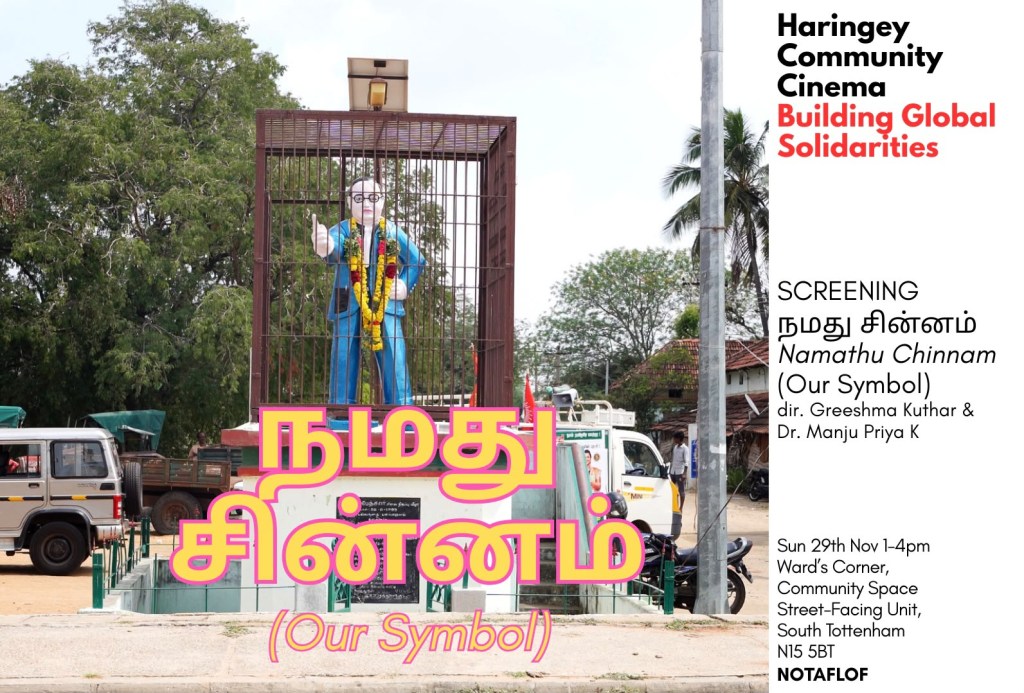
Second screening (November): நமது சின்னம்? (Our Symbol Is?)
Date/Time: 29 November 2026, 1.00 pm to 4.00pm
Location: Wards Corner,Community Space Street-Facing Unit, South Tottenham, London N15 5BT
Guest: Film makers Greeshma Kuthar and Dr. Manju Priya K will join us online with subject specialists. Volunteers from India Labour Solidarity.
Booking: Evenbrite (Soon)
Third screening (December): Ghost Platform: Organizing Against Invisibility
Date: 2nd December 2026, 7.30pm-9.30pm
Location: Chestnut Community Centre, 280 St Ann’s Rd, London N15 5BN
Guest: Benj Gerdes
Booking: Eventbrite (Soon)
About the films
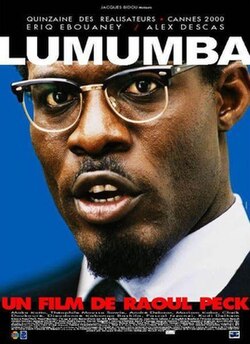
LUMUMBA (dir. Raoul Peck, 2000)
Raoul Peck’s Lumumba (2000) tells the story of Patrice Lumumba, a leader of the Congolese independence movement who became the first Prime Minister of the newly independent Republic of the Congo in 1960.
Moving between the final years of Belgian colonial rule, the struggle for independence and the political crisis that followed, Peck traces the extraordinary rise of Lumumba and the forces that gathered against his government. Within months of independence, Lumumba was removed from power, imprisoned and, in January 1961, assassinated.
Through Lumumba’s story, the film confronts one of the central contradictions of the era of decolonisation: what does political independence mean when former colonial powers continue to exercise enormous economic and geopolitical power?
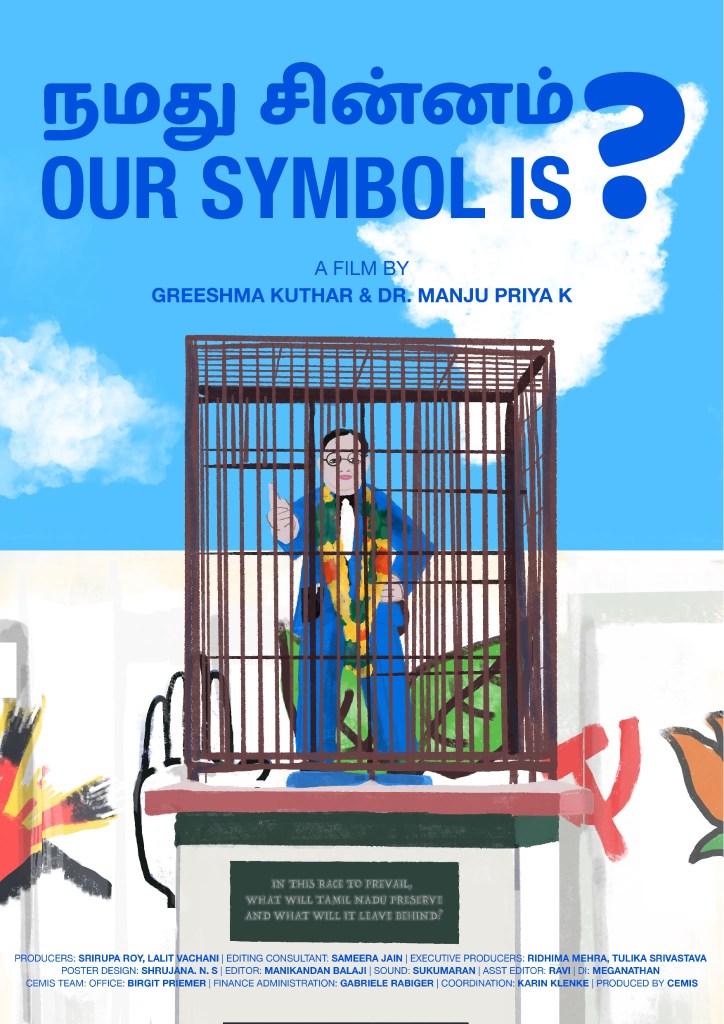
நமது சின்னம்? (Our Symbol Is?) (dir. Greeshma Kuthar and Dr. Manju Priya K.)
“Our Symbol is?” explores a state at a turning point: who defines its symbols, who benefits from their meaning, and in this struggle for power and identity, what will Tamil Nadu preserve and what will it leave behind?
As Hindu nationalism and other dominant ideologies seep into Tamil Nadu’s political context, a cultural battleground takes shape where identity is contested, symbols are repurposed, and tradition is strategically redefined. Political parties compete to control narratives through appropriation, even as caste capital and social hierarchies remain firmly rooted.
“Our Symbol is?” explores a state at a turning point: who defines its symbols, who benefits from their meaning, and in this struggle for power and identity, what will Tamil Nadu preserve and what will it leave behind?
We will be joined by the film makers and subject experts post the screening for a discussion.
Ghost Platform: Organizing Against Invisibility, Collective, 2026, 60min
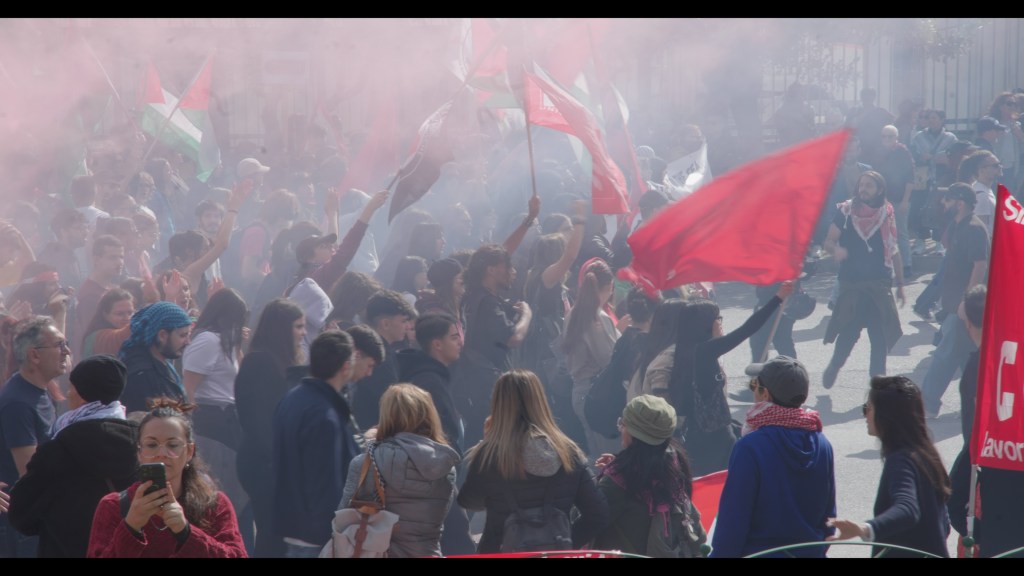
Ghost Platform is a collaborative video initiative bringing together worker-organizers, artists and researchers to investigate the invisibilization of human labour in contemporary cargo logistics and data infrastructure. Using custom software for secure collaboration, the group filmed in response to the rising inequality, political repression, and ecological impact enabled by these systems. To contradict the stories told by Amazon, Meta, Google, Microsoft, etc, the episodic structure of the film looks at groups in Europe and beyond as they struggle to resist exploitation and build cross-border alliances. Filming from 2022-2025 documented unprecedented shifts: post-pandemic cargo logistics met questions around Russia’s invasion of Ukraine, Europe’s (re)turn to a war economy, and organising in resistance to Israel’s perpetration of genocide in Gaza. The film captures moments in Italy and elsewhere where dockworkers and grassroots logistics unions have been at the forefront of blockades and refusals to load or unload military cargo. It also reflects upon the direct and severe repression these efforts have faced as a result. As the film’s chapters criss-cross supply chains, seeing that it is the same ships and data centers conveying goods and information—holiday gifts, the latest AI slop, or fighter jet and bomb parts headed for further human devastation—asks what models and new alliances could succeed today? As we seek to organize for more just and equitable futures, documenting logistics struggles provokes a different understanding of the terrain of the present and what may be possible.
Credits:
Ghost Platform originated as an artistic research project, conceived and led by the artist Benjamin Gerdes (US/SE) as a way to connect sites across supply chains, building on his prior work filming in solidarity with militant dockworkers in Sweden. The network between 2022 and 2025 grew to include collaborations with members and organizers from the labor unions: SI Cobas (Italy), Amazon Workers International & OZZ Inicjatywa Pracownicza (Poland), Confederación Sindical de Comisiones Obreras (CCOO) (Spain), Unión General de Trabajadores (UGT) (Spain), Svenska Hamnarbetarförbundet (Sweden), SAC Syndikalisterna (Sweden), Villa Medusa social centre (Italy), Unione Sindicale di Base (USB) (Italy), Collettivo Autonomo Lavoratori Portuali (CALP) (Italy). This was made possible through the work of specific artists and researchers: Bahaleen Collective (Aya Besio and Noura Salem) (Jordan), Benjamin Gerdes (Sweden) Christopher Byrnes (Spain), Daniel López (Spain), Elia Wehaiba El Khazen (Germany/Lebanon), Felicia Fahlin (Sweden), Gabriella Cioce (Italy), Magda Malinowska (Poland), Michele Amaglio (Italy), Pedro Exposito (Spain), Peppe D’Alesio (Italy), Robert Ochshorn (USA/Belgium) Karin Krifors (Sweden), Hege Høyer Leivestad (Sweden/Norway), Rati Kupatadze (Sweden). The footage is also released to participants for their own purposes.
About Guest Speakers
Elvis Katoto — Filmmaker and Humanitarian
Elvis Katoto is a Congolese documentary filmmaker, multimedia producer and humanitarian based in England. He holds a Master’s degree in Cinema and a diploma in Television Production from Teesside University. Through film and storytelling, he amplifies underrepresented voices and raises awareness of humanitarian crises.
Through his documentary work in Goma, eastern Democratic Republic of Congo, and his leadership of Ubuntu DRC, Elvis documents the experiences of displaced communities and supports vulnerable children, survivors of sexual violence, young mothers and families affected by conflict. His mission is to transform powerful stories into greater awareness, solidarity and meaningful action.
Follow and support his work:
- Watch his documentaries and learn about his humanitarian projects: Ubuntu Heart
- Follow his social media and find donation links: Elvis Katoto’s Linktree
- Support humanitarian projects directly: Visit the donation links on his Linktree to help vulnerable communities in Goma.
Dr Kiruba Munusamy ESRC Postdoctoral Fellow, with a PhD in Law and Advocate, Supreme Court of India and Founder, Legal Initiative For Equality; Mapping Caste Atrocities.
Mr Abhishek Bhosale is a anti-caste resarcher currently based at SOAS University of London Doctoral Researcher. He is currently President of the SOAS Ambedkar Society, is a student-led initiative for debate, discussion and new critical understanding of the various struggles of liberation against systemic oppression worldwide.
Benjamin Gerdes is an artist, writer, and organiser working in video, film, and related public formats, individually as well as collaboratively. He is interested in intersections of radical politics, knowledge production, and popular imagination. His work focuses on the affective and social consequences of economic and state regimes, investigating methods for art and cultural projects to contribute to social change. Gerdes’s projects emerge via multiple articulations from long-term research processes conducted in dialogue with activists, trade unionists, architects, urbanists, geographers, and archival researchers. Originally from the United States, he is surprised to have been based in Sweden for the past 7 years.


Leave a Reply